A whole month of lighting one small flame each evening. Thirty stories, the practices families keep, every date and a lamp diary, all in one free guide.
Tap the lamp to light it
The month, explained
What is Karthika Masa?
Karthika is the month of lamps. It begins the day after Deepavali, as evenings grow shorter, and for about a month families light a small flame at dusk. It is named after the Krittika stars (the Pleiades), because the full moon of this month shines close to them.
Is there one story behind it?
Not one. Different families and regions remember Karthika through different stories, and each one ends in the same place: a lamp lit against the dark. That lamp is the heart of the month.
Shiva, the light that cannot be measured
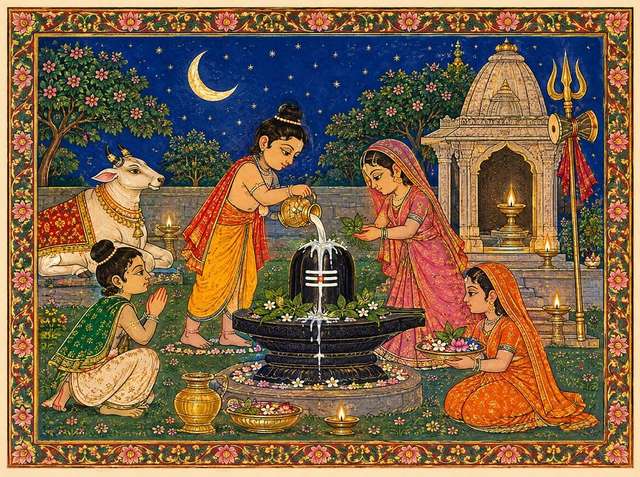
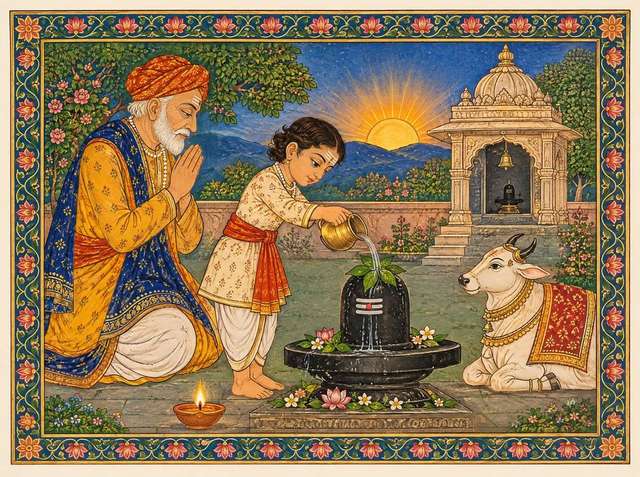
On the full moon, Shiva is remembered as Tripurari, who ended the power of three flying cities. The gods lit lamps for joy, so the night is called Dev Deepawali. Mondays of the month are for Shiva, and the great flame on Arunachala hill recalls his pillar of fire.
Vishnu and Krishna, the lamp of love
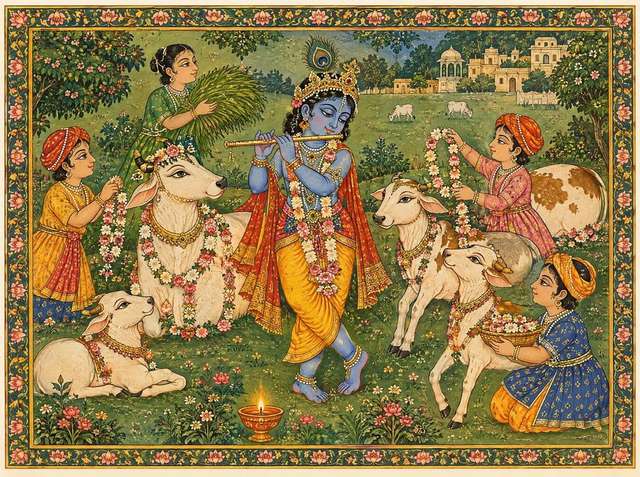
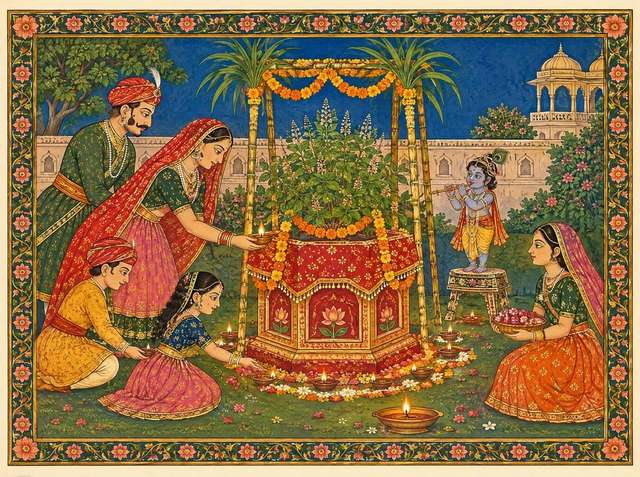
Vishnu wakes from his long rest, and the tulasi plant is married to him with lamps all around. Many Vaishnava families call this Damodara month, after baby Krishna whom Yashoda bound with a rope, and offer a ghee lamp to him every day.
Murugan and the Krittika stars
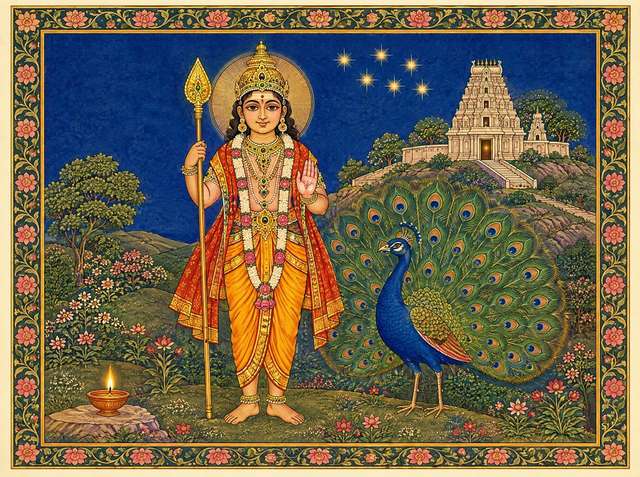
Karthika and Kartikeya share a root: the month is named for the six Krittika stars, and Murugan is called Kartikeya, “son of the Krittikas”, for the six star-mothers who nursed him. The six-day Kanda Sashti begins on the first day of Karthika and ends with Soorasamharam. In Tamil Nadu, the Karthigai Deepam also honours the Krittikas, with a giant flame on Arunachala.
What families do
Light a lamp each eveningAt dusk, at the tulasi or the prayer corner. Some families also light one at dawn.
Keep Mondays for ShivaSomavaram: a quiet prayer, and for some a fast until the stars appear.
Honour the tulasiWater it, circle it, and decorate it for Tulasi Vivah.
Give and feed (annadanam)Sharing food and giving lamps, ghee or clothes to others is the other great practice of the month.
Bathe early, eat simplyA pre-dawn bath (Karthika Snanam) and simple, sattvic food are traditional through the month.
Eat together under the amla treeVana Bhojanam: a shared meal in a garden, especially in Telugu families.
Traditions differ by region and family, and not everyone does all of this. Keep what is meaningful to you. A single lamp is enough.
What families do
Practices and blessings
The things people do in Karthika, and the blessings the traditional texts say come with them. Take what is meaningful to you.
A simple starting point for a busy family: a lamp, a Monday prayer, a little giving, and one story a day. Somavaram is every Monday of the month, so keep as many as you can, even if some Mondays are only a short prayer and a lamp. Everything below is for families who want to do more.
Deepa Daanam: the lamp offering
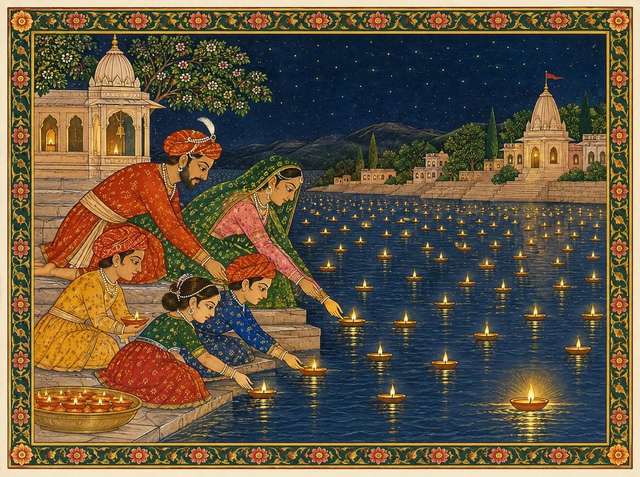
Light a lamp every dusk at the tulasi, the doorway and the prayer corner, with ghee or sesame oil. On Karthika Pournami many families light 365 wicks together. Lighting lamps at a temple, or giving lamps and oil, is also deepa daanam.
Tradition saysThe Skanda Purana praises lamp offering in this month above almost any other act. Sins of many births are said to fall away, and the ancestors of the family are said to be freed through it. Even one lamp lit with devotion counts.
Annadanam and giving
Feed people who are hungry. Give food, ghee, lamps, blankets, clothes or books to temples and to people in need. A shared meal at a temple or a local food bank counts.
Tradition saysCharity given in Karthika is said to bring multiplied merit. On Karthika Pournami, any act of giving is said to bring the blessing of ten great sacrifices.
Karthika Somavaram: Shiva Mondays
On every Monday of the month, bathe early, visit a Shiva temple and offer bilva leaves, milk and water. Many families do or sponsor a Rudrabhishekam, the chanting of the Rudram while the lingam is bathed. Some fast until the evening lamp or until the stars appear, or keep a lighter fast of milk and fruit.
Tradition saysTradition tells how the Moon kept this vow and was freed from a curse, which is why Monday (Somavara) is Shiva’s day. The vow is said to bring Shiva and Parvati’s blessings and wear away the weight of past wrongs.
Karthika Snanam: the early bath
Wake before sunrise through the month and bathe, in a river where families can, or simply at home, before the morning prayer and lamp.
Tradition saysThe Skanda Purana is said to describe a bath before sunrise in Karthika as purifying body, mind and spirit.
Tulasi, amla and Vana Bhojanam
Water the tulasi and light a lamp beside it each evening. Tulasi Vivah follows Prabodhini Ekadashi. For Vana Bhojanam, families cook and eat a simple meal together in a garden, ideally under an amla (usiri) tree.
Tradition saysVishnu is said to dwell in the tulasi and Shiva in the bilva tree during this month. Vishnu and Lakshmi are said to rest under the amla tree, so a meal eaten there is a blessed one.
Read a story every day, and chant
Read or hear one chapter of the Karthika Puranam each day. The popular Telugu version has 30 chapters, but a lunar month has 29 or 30 days, so in a 29-day year (like 2026) many families read the last two chapters together on Amavasya. You will find a full retelling of every chapter, with a painting, in the Stories tab. Chant the Vishnu or Shiva Sahasranama, the Damodarashtakam, or simply Om Namah Shivaya. Many keep Ekadashi fasts, and a Satyanarayana Vratam on Pournami.
Tradition saysHearing or reading a chapter a day is held to bring great merit, and small acts of devotion in this month are said to carry the weight of long austerities at other times.
Simple, kind living
Eat simple vegetarian food, and many avoid onion and garlic. Speak gently, avoid anger and gossip, and forgive.
Tradition saysThe month is described as a time to build spiritual discipline, which is the whole point of the observances above.
A note on the blessings
The “what tradition says” lines are the fruits, called phala, that the Puranas and the stories of Karthika attach to each practice. They are traditional beliefs, offered as encouragement and not as promises of any result.
We have taken them from guides to the Skanda Purana and Padma Purana, not from the verses themselves, so a priest or an elder in your family can confirm the exact words and how your own tradition keeps each vow.
A kind caution. Children, pregnant women, older people and anyone unwell are usually advised against strict fasts. A light meal of fruit and milk, or simply lighting the lamp and saying a prayer, keeps the spirit of the vow.
In order
Every date this month
Mark your calendar
Dates not to miss
Three days stand out this year. Tap Add to calendar to set a reminder, or Share to send the date to family.
The whole month
Calendar and lamp diary
Every Monday of Karthika is a Somavaram. Tap any day to see what it holds, and tap I lit a lamp to fill its flame.
Somavaram (Monday)Key dateToday
One chapter a day
30 days, 30 stories
The Karthika Puranam has thirty chapters, read one a day. This year the month has 29 days, so chapters 29 and 30 are read together on Amavasya. Each chapter is retold closely from the Puranam, with a little history first, then the story, then one small thing to do at lamp time.
All thirty chapters
These are close retellings of the Karthika Puranam, in which the sage Vasishtha tells King Janaka the stories, with the names, deeds and order of events kept as the chapters give them. We worked from a published English summary of each chapter, and checked chapters 2, 4, 8, 10, 12 and 13 against a Telugu edition. Please still check against your family copy or an elder. Printed editions divide the chapters in different ways, and details vary between tellings. Chapters marked Teaching are mostly rules and advice, so they come with fewer story events. A few chapters have a note for parents about difficult themes.
Tell these at dusk
Six stories of Karthika
Families tell these stories in slightly different ways, in different regions. Read one aloud before you light the lamp.
1The pillar of fire
One story says Brahma and Vishnu once argued about who was greater. Shiva appeared as an endless column of fire. Vishnu dived down to find its foot and Brahma flew up to find its top, but neither could. Both bowed, understanding that some things are beyond measuring. At Tiruvannamalai, at the hill called Arunachala, this moment is remembered with a great flame lit on the hilltop: the Karthigai Deepam.
2Tripurari Pournami
On the full moon of the month, families remember how Shiva ended the power of the three flying cities of the asura Tripura. The gods lit lamps in joy, and the night is still called Dev Deepawali, the Diwali of the gods. Many families light 365 wicks together, one for every day of the year.
3Vishnu wakes up, Tulasi weds
On Prabodhini Ekadashi, Vishnu is said to wake from his four-month rest. A day or two later comes Tulasi Vivah, when the tulsi plant is decorated like a bride and "married" to Vishnu, with lamps all around. Children often help make the little wedding mandap.
4Why is it called Karthika?
The month is named after the Krittika star cluster, the Pleiades: six or seven tiny stars close together. The full moon of this month shines near them. On a clear evening, go outside, look up and try to count the stars. The same stars give Murugan his name Kartikeya, as the next story tells.
5Murugan and his six mothers
Murugan was born from sparks of Shiva’s fire. Six kind star-mothers, the Krittikas, found the baby and each wanted to feed him. So he grew six faces, one for each mother, and was called Kartikeya, the son of the Krittikas. The six stars are still in the sky, and the month is named after them. Kanda Sashti, the six days of Murugan’s great victory, starts on the very first day of the month.
6Little Krishna and the rope
Baby Krishna was so naughty that his mother Yashoda tried to tie him to a wooden mortar. Each rope she brought was too short, however many she joined together. When she grew tired, Krishna let himself be tied. The story says love can hold even the biggest thing. Because the rope went around his tummy (udara), he is called Damodara, and many families offer him a lamp every day of this month.
One full moon, many names
What is the Pournami called where you live?
The full moon of Karthika is celebrated across India under different names. They all point to the same night of lamps.
Name
Where
What it stresses
Karthika Pournami
Andhra Pradesh, Telangana, Karnataka
Rows of lamps, 365 wicks, crowded Shiva temples
Karthigai Deepam
Tamil Nadu
Rows of lamps at home; the Maha Deepam on Arunachala hill. Also called Bharani Deepam and Vishnu Deepam in Tamil Nadu
Thrikarthika
Kerala
Lamps in homes and temples
Tripurari Purnima or Tripuri Purnima
Maharashtra and widely
Shiva as the one who ended the three flying cities
Dev Deepawali
Varanasi
The Diwali of the gods, with lamps along the river
Kartika Purnima
North India
A holy bath, and lamps floated or offered
Every evening
Lighting a lamp, together
Pick a safe spotA flat surface, on a plate or tray, away from curtains, paper and the edge of a table.
Prepare the lampClean lamp, fresh cotton wick, and oil or ghee. Children can roll the wick between their fingers.
A grown-up lights itUse a long matchstick or lighter. Children can hold the plate steady and say the verse.
Pause for a minuteSit quietly, breathe slowly and say one thing you are grateful for today.
Stay close, then put it out safelyNever leave a burning lamp alone. Let it burn down with a grown-up nearby, or cover it with a small metal lid.
"The light of the lamp is the Supreme. The lamp removes all darkness. Through light everything is accomplished. I bow to the evening lamp."
No open flame? That is fine.Many apartments and some countries do not allow open flames. A small LED or battery lamp works well. What matters is the family pausing together at dusk.
A Pournami tradition
Light the 365 wicks
On Karthika Pournami many families light 365 wicks together, one for every day of the year. Here is a little one to light on screen. Tap, or press and hold, and see the year fill with light.
0 of 365 wicks lit
Pick one a week
Seven ways to celebrate at home
1. A lamp at the doorLight a lamp at dusk at the front door every day, and one beside the tulsi plant if you have one.
2. Decorate a diyaPaint a clay lamp or glue on tiny stones and sequins. Let it dry fully before using it.
3. Make a rangoli or kolamDraw it with rice flour or chalk at the entrance. Children can add colour or flower petals.
4. A quiet Somavaram eveningOn the Mondays: switch off screens, light the lamp, sit together and share one good thing from the week.
5. Vana Bhojanam picnicA Karthika tradition: a family meal outdoors under a tree, often an amla (gooseberry) tree. A park picnic works too.
6. Dedicate a lampOn Karthika Pournami, light a lamp "for" someone: a grandparent, a teacher, a friend far away. Call or write to them.
7. Give some light awayKarthika is a month of giving. Share food, warm clothing or lamp oil with someone who needs it.
Free to print
The Karthika Deepam Family Kit
Four stories and the month's calendar
A 29-day lamp diary to colour in
Two colouring pages: a deepam rangoli and Tulasi with her lamp